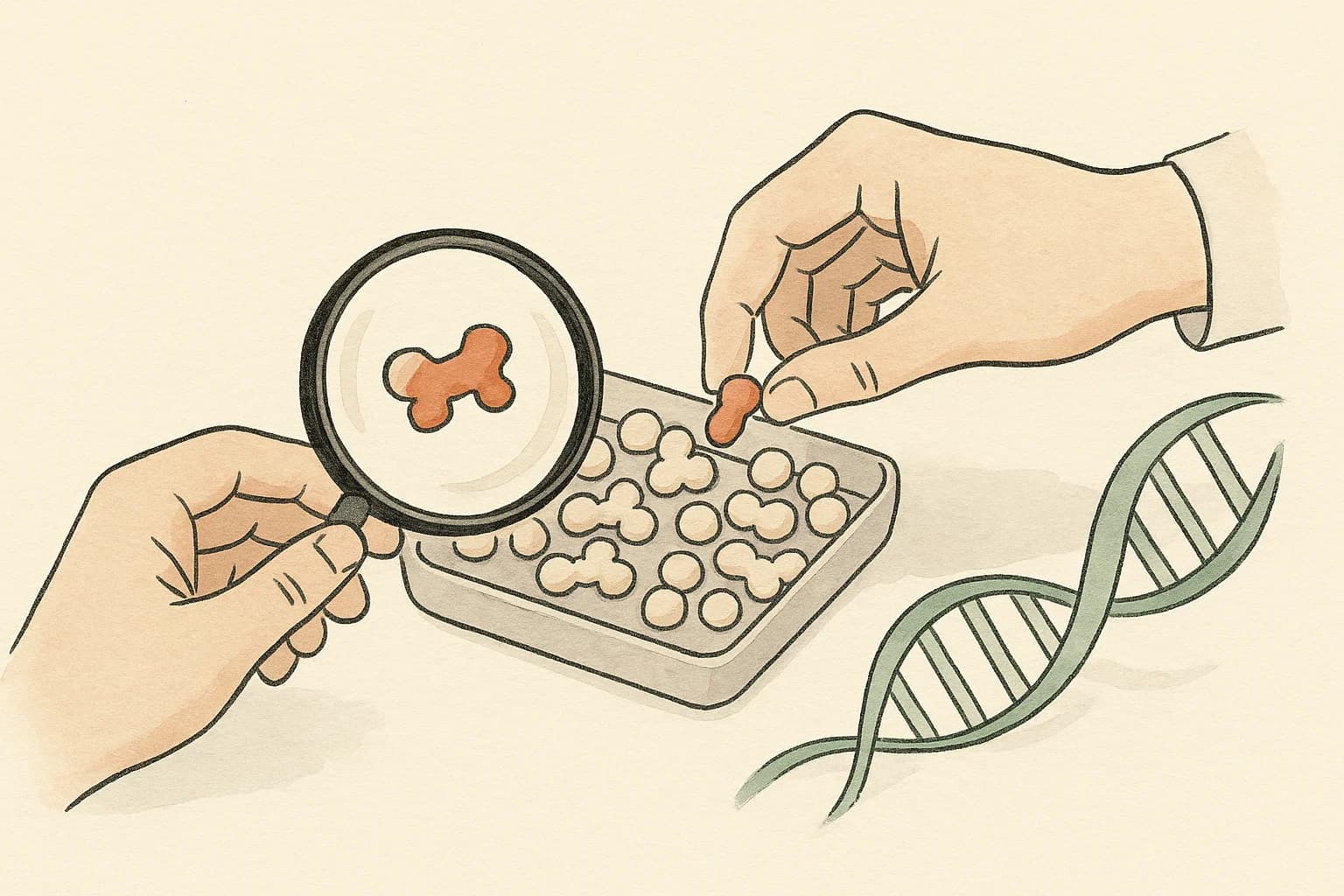
Follow one dog’s journey from diagnosis to personalized neoantigen vaccine treatment.
01 · A dog arrives at the clinic
Start with the patient.
Your veterinarian assesses suitability and coordinates tumour and matched-normal samples.
Could a personalized neoantigen vaccine be a suitable option for this dog?
The journey begins with a diagnosis. The veterinarian reviews the dog’s clinical history, assesses suitability and coordinates tumour and matched-normal sample collection.
Partner: Veterinary oncology clinic
Explore this stage
Could a personalized neoantigen vaccine be a suitable option for this dog?
The journey begins with a diagnosis. The veterinarian reviews the dog’s clinical history, assesses suitability and coordinates tumour and matched-normal sample collection.
Patient & consentClinical samples
Patient & consentClinical samples
02 · Understand the tumour
Every tumour tells a different story.
Sequencing reveals tumour-specific changes, RNA expression and the dog’s immune-genetics context.
What has changed in this tumour that is absent from healthy tissue?
Tumour and matched-normal sequencing help identify tumour-specific changes. RNA evidence and patient-specific immune genetics add context.
Partner: DNA/RNA sequencing laboratory
Explore this stage
What has changed in this tumour that is absent from healthy tissue?
Tumour and matched-normal sequencing help identify tumour-specific changes. RNA evidence and patient-specific immune genetics add context.
Clinical samplesMolecular data
Clinical samplesMolecular data
03 · Neoantigen Retriever
Find the targets worth testing.
Neoantigen Retriever turns molecular evidence into an explainable shortlist of patient-specific targets.
Of thousands of changes, which few deserve laboratory time?
Our computational pipeline narrows tumour-specific changes into a ranked shortlist. DLA molecules help present protein fragments to the dog's immune system. We evaluate which tumour-specific fragments could be recognized.
Partner: N1 Therapeutics · Neoantigen Retriever
Assays and handoffs
Of thousands of changes, which few deserve laboratory time?
Our computational pipeline narrows tumour-specific changes into a ranked shortlist. DLA molecules help present protein fragments to the dog's immune system. We evaluate which tumour-specific fragments could be recognized.
1Identify tumour-specific changes
2Check mutant-expression evidence
3Evaluate compatibility with the dog's DLA molecules
4Consider tumour relevance
5Prioritize candidates for experiments
Molecular dataRanked candidate targets
1Identify tumour-specific changes
2Check mutant-expression evidence
3Evaluate compatibility with the dog's DLA molecules
4Consider tumour relevance
5Prioritize candidates for experiments
Molecular dataRanked candidate targets
04 · Wet-Lab Validation
A prediction becomes a question for the lab.
A specialist laboratory tests binding, stability, immune response and tumour recognition.
Does it bind? Do immune cells respond? Can they recognize the tumour?
Computational ranking is a hypothesis. Experiments decide which candidates have real biological support before anything moves forward.
Partner: Immunology laboratory or CRO
Assays and handoffs
Does it bind? Do immune cells respond? Can they recognize the tumour?
Computational ranking is a hypothesis. Experiments decide which candidates have real biological support before anything moves forward.
How do supported targets become something that can be safely delivered?
Candidates supported by evidence may progress to mRNA construct design, formulation, manufacturing and quality assessment. The lipid nanoparticle protects the RNA and helps deliver it into cells.
Partner: mRNA-LNP formulation & manufacturing team
Explore this stage
How do supported targets become something that can be safely delivered?
Candidates supported by evidence may progress to mRNA construct design, formulation, manufacturing and quality assessment. The lipid nanoparticle protects the RNA and helps deliver it into cells.
If evidence and an authorized protocol support treatment, the veterinarian gives the vaccine and monitors safety and immune response.
How does the dog respond, and what can we learn for the next patient?
If laboratory evidence, product quality and an authorized clinical protocol support treatment, the veterinarian administers the personalized vaccine and monitors safety, immune response and clinical outcomes. Each case helps refine the workflow.
ObservationsBack to Neoantigen Retriever
ObservationsBack to Neoantigen Retriever
The partner network
Find your place in the workflow.
01
Veterinary clinic
Toronto Animal Cancer Centre. Clinical collaboration in discussion
02
Sequencing
Donnelly Sequencing Centre. Prospective sequencing collaborator
03
Neoantigen Retriever
N1 Therapeutics. Computational prioritization
04
Wet-Lab Validation
Canine immunology laboratory / CRO. Options to identify
05
mRNA-LNP manufacturing
Bowen Li’s U of T lab or UBC RNA and Formulation Core. Prospective RNA/LNP options
06
Clinic & monitoring
Returns to the veterinary clinic
Feedback loop. Clinical observations inform the next round of prioritization.
For veterinary clinics
Bring personalized cancer immunotherapy closer to your patients.
01Explore new possibilities for patients with cancer.
02Connect tumour profiling with patient-specific vaccine design.
03Work with coordinated sequencing, immunology and manufacturing partners.
AI product leader and operator, previously at Amazon and Tesco PLC, and founder of Kirak Labs, a Toronto AI product studio. Brings an operations and AI engineering perspective to making personalized cancer immunotherapy cheaper, faster and more accessible. Independently built the award-winning Project Rosie prototype, then brought together researchers in cancer genomics and biology to strengthen it.
Master’s in Management, Innovation and Entrepreneurship · Queen’s University, Smith School of Business
Bachelor of Technology, Electronics and Communication Engineering · IIT Guwahati
Computational leader in translational oncology at the Case Comprehensive Cancer Center. Leads multi-omics strategy and a team of PhD researchers studying small-cell lung cancer, spanning biomarker discovery, ctDNA monitoring and drug-target assessment. Connects rigorous statistical analysis with decisions researchers and physicians can act on.
MS, Biostatistics · Columbia University, Mailman School of Public Health
Bachelor of Technology, Biotechnology · IIT Guwahati
Contributes to Neoantigen Retriever’s computational pipeline development and scientific evaluation, bringing expertise in cancer genomics, deep learning and sequencing workflows. Collaborates with N1 Therapeutics alongside his Medical Biophysics PhD at the University of Toronto.
Doctoral research, Medical Biophysics · University of Toronto
Biology Research Specialization · McMaster University